Restaurant holiday marketing: how to sell more gift cards, catering and party bookings before December 31
A nine-week holiday plan for restaurants in Canada: when to start, how to sell gift cards, win office catering and fill party bookings, the Google, email and pricing rules to follow, templates to copy and a holiday revenue planner.

Restaurant holiday marketing works best as three campaigns run together from early November to New Year’s Eve: gift cards, office catering and party bookings. Start in the first week of November. Put a gift card button on your website and Google profile, and promote a clear bonus offer from Black Friday (November 27, 2026) to Christmas Eve. Pitch catering to nearby offices by mid-November, before party plans are locked in. Publish a holiday party page with set menus, prices that include every mandatory charge, deposit terms and a booking link. Set your holiday hours on Google, email past customers who’ve agreed to hear from you, and track bookings, catering orders and gift card sales every week.
- Canadians plan to spend an average of $911 on the 2026 holidays, down 6.5%, and 64% will look for more deals (RCC and Leger).
- Gift cards make up 16% of Canadians’ planned holiday gift spending, steady from last year.
- OpenTable saw group dining for parties of six or more grow 28% in Canada, and 26% of Canadians want more group and private dining.
- In the US, restaurant gift card sales surged as much as two weeks before Black Friday weekend: start early (Paytronix).
- Gift card sales aren’t charged GST/HST; tax applies when the card is used.
- Most gift cards in Canada can’t expire, but free promotional bonus cards often can, depending on your province. Print the terms on the card.
Key terms explained (16)
- Gift card
- A physical or digital card a customer buys to give someone, worth a set dollar amount at your restaurant.
- E-gift card
- A digital gift card sent by email or text, useful for last-minute buyers.
- Bonus card
- A free promotional card given with a purchase, such as “buy $50, get a $10 bonus card”.
- Redemption
- When someone uses a gift card to pay.
- Breakage
- Gift card value that’s never used.
- Catering
- Food prepared for a group and delivered or picked up, such as trays and boxed lunches for an office.
- B2B (business-to-business)
- Selling to companies rather than individual customers, such as office catering.
- Set menu (prix fixe)
- A fixed menu at a set price per person, common for group bookings.
- Deposit
- Money paid upfront to hold a group booking.
- Private dining
- A separate room or area reserved for one group.
- Google Business Profile (GBP)
- Your free listing on Google Search and Maps, with hours, photos, posts and reviews.
- Special hours
- Temporary opening hours you set on Google for specific dates, such as holidays.
- CASL
- Canada’s Anti-Spam Legislation: the rules for sending marketing emails and texts.
- Implied consent
- Permission under CASL that comes from an existing relationship, such as a purchase in the last two years.
- Drip pricing
- Advertising a price people can’t actually pay because mandatory fees are added later. Misleading under Canada’s Competition Act.
- AGCO
- Alcohol and Gaming Commission of Ontario, which sets rules for how licensed restaurants advertise and promote alcohol in Ontario.
For most restaurants, November and December bring three kinds of extra money at once: people buying gift cards for others, offices ordering food for the team, and groups booking tables for holiday parties. Each needs a different message to a different buyer, and each has a deadline. Party hosts need time to pick a date and invite people, so the restaurants that ask first in November get first choice of the bookings.
This playbook gives you a week-by-week plan, what to do for each of the three, the Google, email and pricing rules that apply in Canada, copy-and-paste templates and a holiday revenue planner that turns your goal into the number of gift cards, catering orders and bookings you need.
Why the holidays matter, and when to start
Holiday spending in Canada is real but careful this year. The Retail Council of Canada and Leger’s 2026 holiday shopping survey (2,500 Canadians, surveyed August 21 to September 4, 2026, as reported by Retail Insider) found:
The same survey found 88% of Canadians rank Black Friday (November 27, 2026) among their top three shopping days, and shoppers expect Black Friday, Cyber Monday and Cyber Week to take about 29% of their holiday budget. OpenTable’s 2026 Dining Trends report for Canada found group dining for parties of six or more grew 28% year over year, and 26% of Canadians want more group and private dining.
When to start: the first week of November. US data from Paytronix, which tracks gift card sales for hundreds of restaurant brands, found sales “surging as much as two weeks before the holiday weekend” in 2024, because brands “front-loaded their gift-card offers earlier.” Party hosts and office managers also need lead time to choose a date and send invites. An offer that first appears in December reaches people who have often already booked elsewhere.
The nine-week holiday calendar
Dates below are for 2026. Christmas Day is a Friday, Boxing Day a Saturday and New Year’s Eve a Thursday.
| Week | Gift cards | Office catering | Party bookings |
|---|---|---|---|
| Nov 2 to 8 | Set up e-gift cards, add a “Gift cards” button to your site and Google profile, decide the bonus offer | Build the catering page and price list; list 30 to 50 nearby offices | Publish the holiday party page with set menus, deposit terms and a booking form |
| Nov 9 to 22 | Soft launch: table tents, receipts, staff mention it at payment | Send outreach emails; follow up after 4 to 5 business days | Email past guests and past party hosts; post an Event on Google |
| Nov 23 to Dec 1 | Bonus offer for Black Friday to Cyber Monday; Google Offer post | Confirm December orders; offer a January reorder price | Push remaining Friday and Saturday dates |
| Dec 2 to 20 | Sell at the table and at pick-up; remind on social media | Deliver; ask happy clients for a review and a January order | Serve parties; collect contact details (with consent) for next year |
| Dec 21 to Jan 3 | Last-minute e-gift card email; keep e-gift cards on sale | Thank-you note; schedule the January reorder reminder | New Year’s Eve; set special hours on Google |
How to sell more gift cards
Gift cards are the easiest holiday sale to add: no extra kitchen work in December, and the card brings someone through your door in the new year. The trick is making them easy to find and easy to buy at the exact moment someone needs a present.

Where to sell them
| Place | What to do |
|---|---|
| Your website | A “Gift cards” button in the header and on the homepage, linking straight to the e-gift card checkout |
| Google Business Profile | An Offer post with dates and terms, plus the gift card link (see the Google section below) |
| At the table and counter | Table tents, a line on the bill, and staff who mention it when people pay |
| Online ordering and pick-up | Add gift cards as an item in your own ordering system and a card in every takeout bag |
| Email and text | To past customers who’ve agreed to hear from you (see the CASL rules below) |
| Corporate buyers | Offer bulk cards to offices as client and staff gifts, in the same email as your catering offer |
Offers that work without giving away margin
- A bonus card, not a discount. “Buy $50, get a $10 bonus card” keeps the full $50 sale and brings the buyer back. The Financial Consumer Agency of Canada’s gift card page notes that promotional cards “often have an expiry date”, while most gift cards don’t expire. Use dates such as January 2 to March 31 so the bonus fills your slowest weeks.
- Price points people already plan. US gift card data from Paytronix put the average restaurant gift card at $66 for full-service restaurants and $31 for quick-service in 2024. Offer amounts near what your guests spend on a meal for two.
- E-gift cards until Christmas Eve. Digital cards are the last-minute shopper’s answer. Say “Delivered by email in minutes” on the button.
Gift cards often bring in more than their face value. A 2017 First Data study of more than 2,000 US consumers, reported by Hospitality Technology, found 81% of fast-casual gift card users spent more than the card’s value, by about $20 on average. It’s older US data, so treat it as a direction, not a forecast.
The rules for gift cards in Canada
| Rule | What it means for you | Source |
|---|---|---|
| Expiry dates | “Most gift cards don’t expire.” Promotional cards and cards for a specific service may, depending on your province. Check your province’s rules before printing. | FCAC |
| Fees | “In general, there are no fees to buy or use a gift card.” Some provinces allow limited fees, such as replacing a lost card. | FCAC |
| Sales tax | “Sales of gift cards and gift certificates are not taxable.” GST/HST applies when the card is used, on what’s bought. | Revenu Québec (GST/HST and QST) |
| Alcohol (Ontario) | The AGCO says gift cards may be accepted for alcohol if they’re available to everyone, but coupons for alcohol aren’t allowed. Keep bonus cards general, not “a free bottle of wine”. | AGCO |
One accounting note: gift card money isn’t revenue until the card is used. Your accountant will usually record it as owed to customers until then, so plan January staffing for the redemptions.
How to win office catering orders
Many offices skip a big evening party and order lunch for the team instead. That’s catering, and it’s sold business to business (B2B): one decision-maker, often an office manager or executive assistant, ordering for 15 to 100 people.
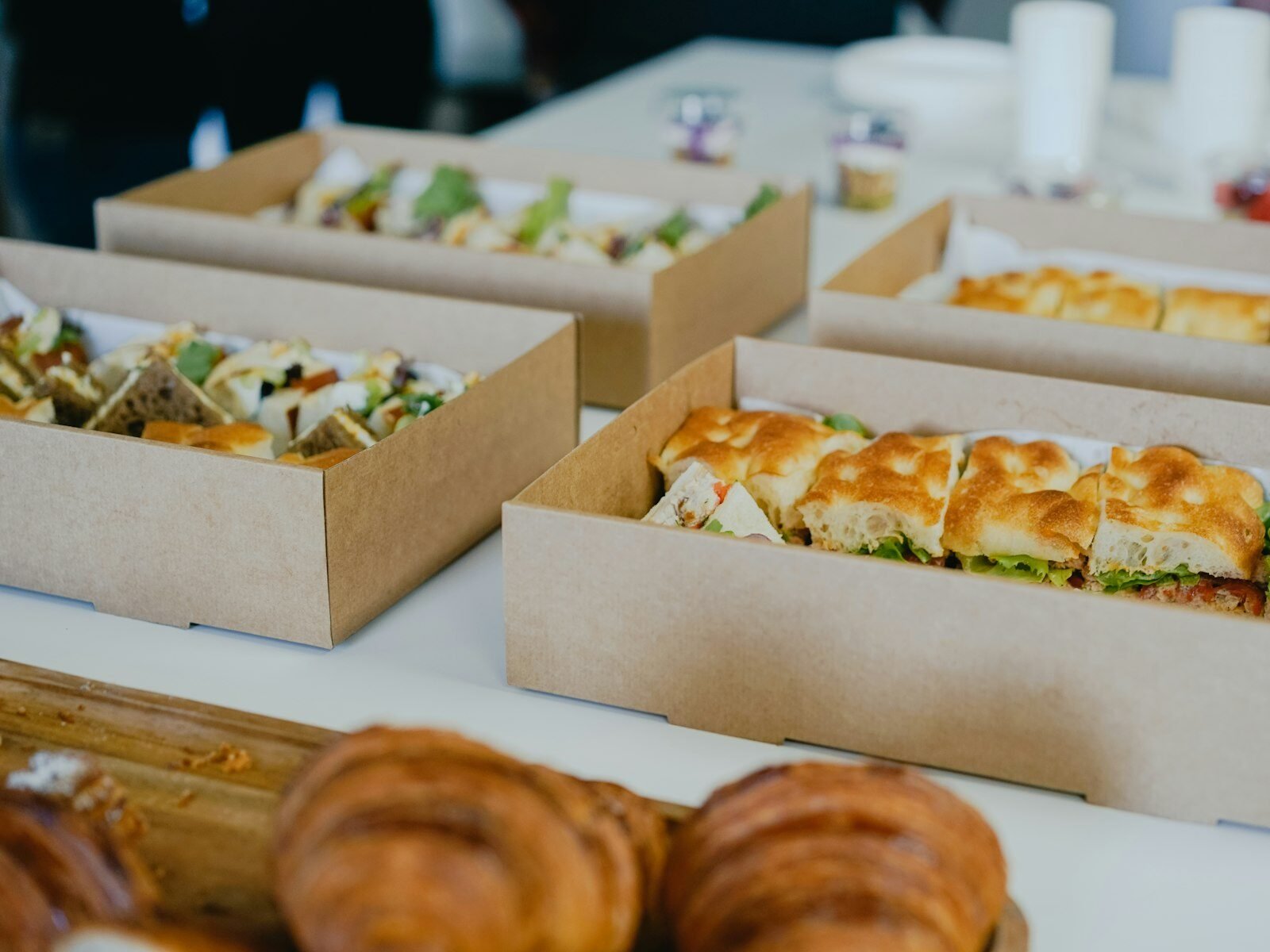
- Build one catering page. Packages priced per person (for example, a boxed lunch, a hot buffet and a dessert tray), the minimum order, the order deadline (such as 48 hours), delivery area and fee, dietary labels (vegetarian, gluten-free, halal where true) and an order or quote form. Use your real prices and make sure any mandatory delivery or service charge is in the price you show (see the pricing section).
- List nearby offices. Start with 30 to 50 businesses within your delivery radius: offices, clinics, schools, car dealerships, property managers. Find the person who orders food.
- Email the right person, the right way. CASL allows implied consent when a business email address is published, for example on a company website, with no “no marketing” note, and your message relates to the person’s role. The CRTC’s guidance on implied consent sets out the conditions. Every message needs your business name, contact details and an unsubscribe link.
- Follow up once. A short second email after four or five business days, then stop.
- Turn December into January. Every holiday catering client gets a thank-you and a January reorder offer. January is quiet for restaurants and busy for office lunches and meetings.
Subject: Holiday team lunch for [company], delivered
Hi [first name],
If you’re planning a team lunch this December, we can take it off your list. [Restaurant] delivers [boxed lunches / hot buffets] for 15 to 100 people around [area], from $[price] per person, with vegetarian and gluten-free options labelled.
Order by [deadline] for dates up to December 23. Here’s our menu and price list: [link]
Happy to send a quote for your group size.
[Your name], [Restaurant], [phone], [address]
Don’t want to hear from us? Reply “unsubscribe” or click here: [link]
How to fill holiday party bookings
Party hosts compare three things: price per person, what’s included and how easy it is to book. Make all three obvious on one page.
| On your holiday party page | Why it matters |
|---|---|
| Two or three set menus at clear price tiers per person | Hosts budget per head. Tiers let them choose without a back-and-forth |
| Group sizes and spaces: largest table, semi-private area, private room | Answers “Can you fit 24 of us?” before they call |
| Available dates, updated weekly, with Fridays and Saturdays marked | Creates honest urgency and saves phone time |
| Deposit and cancellation terms in plain words | Protects you from no-shows and builds trust |
| Every mandatory charge included in the price you show | Required under the Competition Act’s drip pricing rules (see below) |
| A booking form or link plus a phone number | Planners book at their desk, often during work hours |
| Quick answers: dietary needs, AV, parking, accessibility | The questions that slow bookings down |
OpenTable’s research also found 32% of Canadians are more likely to dine at a restaurant hosting a pop-up, collab or special event, so a ticketed holiday dinner or a New Year’s Eve set menu can fill quieter nights. Then email past party hosts first: someone who booked with you last December is your warmest lead.
Google, your website and holiday hours
Most people check Google before they book, buy or show up. Three things to set before mid-November:
- Special hours for every holiday. Google’s special hours help page says special hours appear “only for the designated days”, and recommends confirming hours for official holidays even when they don’t change, because it “makes it clear to customers that your special hours are accurate.” Special hours cover up to 6 days in a row; if you close for 7 or more days, mark the business temporarily closed instead.
- Offer and Event posts. Google’s posts help page says Offer posts need a title and dates and can include a coupon code, link and terms; Event posts need a title and start and end dates. Two catches: posts with a phone number in the text may be rejected, and businesses in regulated industries, including alcohol, can’t post content about those products. Promote the dinner, not the drinks.
- A holiday page on your website. One page answering the questions people ask: holiday hours, party menus and prices, catering deadlines, gift cards. Search engines and AI assistants like ChatGPT and Gemini can quote a clear, dated page with direct answers. The AI search visibility playbook explains how.
The Google Business Profile guide covers every other field. If you run several locations, set hours and posts for each one; the multi-location restaurant playbook shows how.
Email, texts and social media
Your past guests are the cheapest holiday customers to reach. Under CASL, the CRTC’s guidance says implied consent can come from a purchase in the last two years or an inquiry in the last six months, and every message must identify you and include an unsubscribe option. Opt-outs must be processed within 10 business days. Texts follow the same rules as email.
| When | Message | Goal |
|---|---|---|
| Week of Nov 9 | “Your holiday party, sorted”: set menus, dates, booking link | Party bookings |
| Nov 26 or 27 | “Black Friday: a $10 bonus card with every $50 gift card” | Gift cards |
| Dec 10 | “A few dates left”: remaining party and catering slots | Bookings and catering |
| Dec 21 or 22 | “The present that arrives in minutes”: e-gift cards | Last-minute gift cards |
| Dec 28 | Holiday hours and New Year’s Eve | Visits and reservations |
Subject: Still shopping? This one arrives in minutes
Hi [first name],
If there’s still a name on your list, a [Restaurant] e-gift card lands in their inbox in minutes. Choose any amount from $[amount], add a note, done.
[Buy an e-gift card]
Our holiday hours: [dates and hours]. We’d love to see you before the year’s out.
[Restaurant], [address]
Unsubscribe: [link]
On social media, show the real thing: the party room set for 20, catering boxes going out the door, the team in holiday sweaters, a gift card tucked into a card. Short vertical video works well; the bakery and snack social media playbook has a content plan you can adapt for restaurants, and the Halloween playbook covers contest rules if you run a giveaway.
Pricing and promotion rules to follow
- Show prices people can actually pay. The Competition Bureau defines drip pricing as “offering a product or service at a price that is unattainable because consumers must also pay additional charges or fees.” Only government charges such as sales tax can sit outside the advertised price. If party menus or catering carry a mandatory service charge, delivery fee or room fee, include it in the per-person price you advertise, or show the all-in price just as clearly.
- Alcohol promotions (Ontario). The AGCO’s advertising and promotion guidelines for licensed restaurants allow advertising drink prices if it’s responsible, but ban multi-drink deals such as “2 for 1”, ban coupons for alcohol and ban promotions aimed at specific groups. Other provinces have their own rules.
- Bonus card terms in writing. Put the value, valid dates and any limits on the bonus card itself and on the offer page.
This is general information, not legal or tax advice. Check gift card, pricing and alcohol rules for your province, and gift card accounting with your accountant.
Plan your holiday revenue
Enter your goal for extra holiday revenue from these three campaigns and your own averages. The planner shows how many party bookings, catering orders and gift cards you need, and the weekly pace to hit them.
Holiday revenue planner
Type over the examples. Nothing is saved or sent anywhere.
How the goal splits (%)
Your averages
Example numbers are made up: use your own averages from last December or your point-of-sale reports. Gift card sales are counted here when sold, but they become revenue when they’re used.
The "a quarter of offices order" figure in the planner is a planning assumption, not a benchmark. Replace it with your own reply rate after the first week of outreach.
What to measure
| Measure | Where to find it | Check |
|---|---|---|
| Party bookings and covers (guests booked) | Reservation system or booking form | Weekly, against the planner's pace |
| Catering quotes, orders and reply rate | Your inbox or CRM (customer relationship management tool) | Weekly |
| Gift card sales by channel: online, in person, corporate | Gift card provider or point of sale | Weekly, daily around Black Friday |
| Google profile actions: calls, website clicks, directions | Business Profile performance | Weekly |
| Email results: clicks and sales per email | Email platform with tracked links | After each send |
| January redemptions and spend over card value | Gift card provider or point of sale | Monthly from January |
After New Year's, write down what sold, which dates filled first and which offices ordered. That list is next year's head start. The monthly marketing report playbook shows how to put it on one page.
Holiday checklist
Tick these off as you go. Your progress is saved in this browser.
- Holiday revenue goal set, split across parties, catering and gift cards.
- E-gift cards are on sale, with a "Gift cards" button on the website.
- Bonus card offer chosen, with value, valid dates and terms printed on the card.
- Holiday party page live: set menus, all-in prices, dates, deposit terms and booking form.
- Catering page live: per-person packages, minimum order, deadline, delivery area and dietary labels.
- List of 30 to 50 nearby offices built, with the right contact and a published business email.
- Catering outreach sent by mid-November, with one follow-up.
- Past guests and past party hosts emailed (with consent), each message with an unsubscribe link.
- Google special hours set for Dec 24, 25, 26, 31 and Jan 1, including days with normal hours.
- Google Offer post for gift cards and Event post for parties, with no alcohol content.
- Staff briefed to mention gift cards and party bookings at payment.
- Advertised prices include every mandatory charge except sales tax.
- January plan ready: catering reorder reminder and a welcome for gift card holders.
Tools for the job
| Tool | Use it for | Cost |
|---|---|---|
| Your point-of-sale or gift card provider | Selling physical and e-gift cards and tracking redemptions | Usually part of your point-of-sale plan or a per-card fee |
| Google Business Profile | Special hours, Offer and Event posts, booking and order links | Free |
| Your reservation system | Group bookings, deposits and a booking link for your site and Google profile | Varies |
| An email platform | Past-guest emails with tracked links and unsubscribe handling | Free and paid plans |
| Canva | Gift card designs, table tents, menus and social posts | Free and paid plans |
Features, prices and rules change. Check each provider's and regulator's page for current details.
Frequently asked questions
When should restaurants start holiday marketing?
In the first week of November. Party hosts and offices need lead time to book, and US data from Paytronix shows restaurant gift card sales surging up to two weeks before Black Friday weekend.
How can a restaurant sell more gift cards over the holidays?
Sell e-gift cards online with a button on your website and Google profile, mention them at every payment, offer a bonus card such as $10 with every $50 from Black Friday to Christmas, and keep e-gift cards on sale until December 24.
Can restaurant gift cards expire in Canada?
Most gift cards don't expire, according to the Financial Consumer Agency of Canada. Promotional cards given free, such as bonus cards, often can, depending on your province. Print the value and dates on the card.
Do you charge GST or HST when selling a gift card?
No. Selling a gift card isn't taxable. GST/HST is charged when the card is used, on the food and drinks bought.
How do restaurants get more holiday party bookings?
Publish a holiday party page with two or three set menus at clear per-person prices, available dates, deposit terms and a booking form, then email past guests and last year's party hosts in early November.
Can I email offices about holiday catering under CASL?
Often yes, if the person's business email is published, for example on their company website, without a "no marketing" note, and your message relates to their role. Every email needs your contact details and an unsubscribe option.
Related playbooks
Browse every playbook on marketing strategy, or see all marketing playbooks.
Sources
- Canadians plan to spend less on holidays as budgets tighten: survey (RCC x Leger 2026 Holiday Shopping Survey)Retail Insider · Mario Toneguzzi · October 20, 2026
- 2026 Dining Trends ReportOpenTable Canada · updated January 6, 2026
- Paytronix data finds restaurant gift card sales peaked early on Thanksgiving weekendPaytronix · December 16, 2024 (US data)
- Consumers overspend the value of their gift cards significantly within the restaurant industryHospitality Technology · First Data 2017 Prepaid Consumer Insights Study (US)
- Gift cardsFinancial Consumer Agency of Canada · modified October 23, 2026
- Gift cards and gift certificates: GST/HST and QSTRevenu Québec · checked October 30, 2026
- Registrar's guidelines for advertising and promotionAlcohol and Gaming Commission of Ontario · checked October 30, 2026
- Guidance on implied consent under Canada's anti-spam legislationCRTC · checked October 30, 2026
- How to set special hoursGoogle Business Profile Help · checked October 30, 2026
- Create a post for your Business ProfileGoogle Business Profile Help · checked October 30, 2026
- Drip pricingCompetition Bureau Canada · updated August 24, 2026
Remar Catapang is a full-funnel marketing strategist based in Ontario, Canada. He has worked in marketing since 2020 and continues to lead search, CRM automation, web, paid media and experiential campaigns for businesses in Canada, the United States, Australia, Egypt and the Philippines. His playbooks are based on that ongoing work. Questions about this playbook: remarcatapangjr@gmail.com