Black Friday marketing plan for small businesses: a 6-week countdown
A week-by-week Black Friday plan for shops and service businesses: pick an offer that still makes money, build your list, and run the weekend calmly.

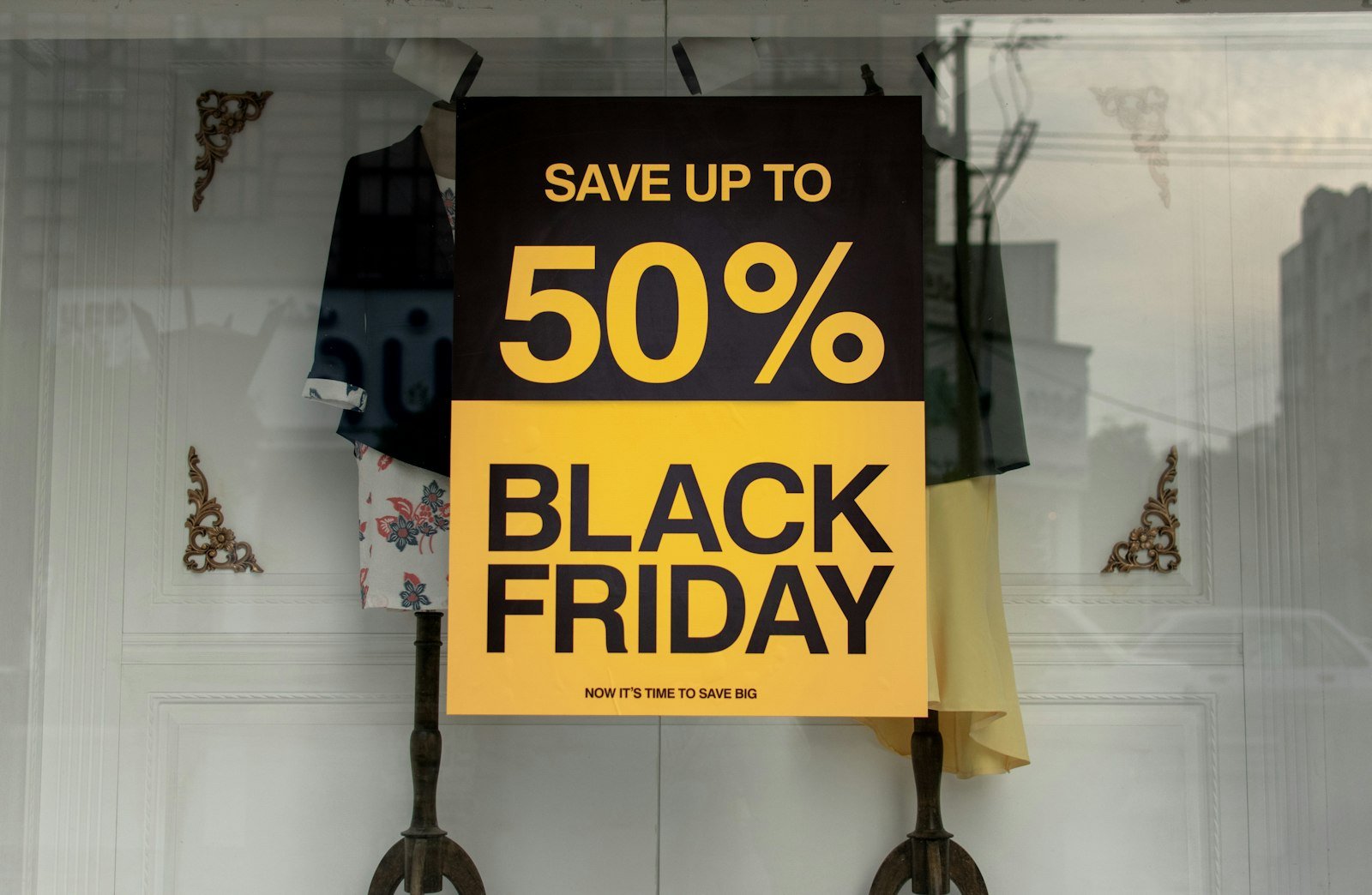
Start six weeks before Black Friday, which falls on November 27 in 2026. Choose the offer first and check what the discount does to your profit. Then spend one week each on growing your email list, building the sale page and emails, teasing the sale, giving your list early access, and testing everything. Run the offer from Black Friday to Cyber Monday, end it when you said you would, and follow up with every new customer.
- Black Friday is November 27, 2026 and Cyber Monday is November 30. A six-week plan starts on October 16.
- A discount comes out of profit. With a 50% margin, 20% off means you need 1.67 times your usual sales to earn the same profit.
- Offers that add value, such as bundles, upgrades and gift card bonuses, protect your price.
- Your own email list is the cheapest channel that week. Start growing it in October.
- In Canada, the regular price and the deadline in your ad both have to be real.
- Plan the thank-you, the review request and the results count before the sale starts.
Key terms explained (13)
- Black Friday
- The Friday after American Thanksgiving. It is one of the biggest shopping days of the year. In 2026 it falls on November 27.
- Cyber Monday
- The Monday after Black Friday, known for online deals. In 2026 it falls on November 30.
- BFCM
- Short for Black Friday Cyber Monday. It means the four days from Black Friday to Cyber Monday.
- Profit margin
- The share of the price you keep after paying what it costs to deliver the sale. A $100 item that costs you $50 has a 50% margin.
- Offer
- What the customer gets, what it costs and when it ends. A discount is one kind of offer.
- Bundle
- Two or more products or services sold together at one price.
- Email list
- The people who gave you their email address and agreed to hear from you.
- Early access
- Letting one group, usually your email list, buy before the public.
- Landing page
- A single web page built for one offer, with one button.
- QR code
- A square barcode that opens a web page when someone points a phone camera at it.
- CASL
- Canada’s Anti-Spam Legislation. It sets the rules for marketing emails and texts, including consent and unsubscribe links.
- Competition Bureau
- The Canadian federal agency that enforces the rules on advertising, including sale price claims.
- Google Business Profile
- Your free business listing on Google Search and Google Maps.
Black Friday is November 27, 2026. Cyber Monday is November 30. Most small businesses start thinking about it in the middle of November, pick a discount in a hurry, send one email, and hope. This playbook gives you a calmer way to do it: six weeks, one job a week, and an offer you have checked against your own numbers.
It is written for shops, online stores and service businesses. You do not need a big budget. You need a clear offer, a list of people who asked to hear from you, and a plan for the four days.
Why Black Friday is worth planning for
Black Friday started as a one-day sale in American stores. It is now a long weekend of online and in-store shopping that runs from Black Friday to Cyber Monday. People often shorten that to BFCM (Black Friday Cyber Monday).
The numbers are large, and they come from places you can check:
- In Canada, the Retail Council of Canada and Leger 2025 holiday shopping survey of more than 2,500 shoppers found that 84% named Black Friday as a key shopping day, ahead of Boxing Day at 55%. It also found that 85% wait for sales and 86% plan to shop close to home.
- In the United States, Adobe Analytics counted $11.8 billion in online sales on Black Friday 2025, up 9.1% from the year before, and $14.2 billion on Cyber Monday.
- For independent brands, Shopify reported that its merchants sold $14.6 billion over the 2025 weekend, up 27%, with sales peaking at 12:01 p.m. Eastern on Black Friday.
Two details matter for a small business. First, shoppers in the Canadian survey said they plan to shop close to home, so being local is an advantage. Second, Adobe found that more than half of online holiday purchases (56.4%) were made on a phone. Your sale page and your emails have to work on a small screen.
Why six weeks and not one
People start earlier than most owners think. A Google and Ipsos holiday study of shoppers in the United States found that by the end of October, the average shopper had already finished 29% of their holiday shopping. The study is from the 2022 season, so treat it as a pattern and not a current figure. The pattern is the useful part: by the time you announce your sale, many people have already decided where to look.
Six weeks also gives you time for the slow jobs. Growing an email list takes weeks. Testing a checkout or a booking form takes a quiet afternoon you will not have in late November. And if you plan to run ads, ad platforms need a few days to learn who responds. The Meta ads budget playbook explains why a campaign that starts on the Thursday night rarely settles in time.
Decide the offer first: what a discount does to your profit
The offer is the most important decision, so make it in week 6. Most people pick a discount because a competitor did. Check the maths before you do.
A discount comes straight out of your profit, not your price. Here is a worked example. You sell something for $100. It costs you $50 to deliver. Your profit is $50. At 20% off, the price drops to $80 and your profit drops to $30. You took 20% off the price and 40% off the profit. To earn the same total profit as a normal week, you now need 1.67 times as many sales.
Discount calculator: what does the sale do to your profit?
Enter your own numbers. The calculator shows what you keep on each sale and how many sales you need to match a normal period.
Cost to deliver one sale means the product, packaging, card fees and shipping, or the labour and materials for a service. The starting numbers are examples, not benchmarks.
For context, Adobe found that the average online discount in the United States on Black Friday 2025 was 23.7%. Those averages are set by very large retailers with very large volumes. You do not have to match them. A smaller discount on your best seller, or an offer that adds value without cutting the price, often leaves you with more money.

Keep the sale honest
In Canada, the Competition Bureau is the federal agency that enforces the rules on advertising. Two of its rules apply directly to Black Friday.
- The regular price has to be real. The Bureau's page on ordinary selling price says "businesses cannot invent a higher regular price to make a sale look like a bargain when it's not." You must be able to show that you sold the item at the regular price, or offered it at that price in good faith for a substantial period.
- The deadline has to be real. The Bureau's page on fake urgency cues warns against countdown timers that run out or reset while the offer stays available, and against "only 2 left" claims that never change.
This is general information, not legal advice. If you are unsure about a claim, ask a lawyer before you publish it.
Offers that do not cut your price
A percentage off is only one kind of offer. Service businesses in particular have better options, because their main cost is time. Here are offers that work for shops and for services.
| Offer | How it works | Good for |
|---|---|---|
| Bundle | Group two or three things at one price that is lower than buying them one by one. | Shops with slow-moving items; services with add-ons |
| Gift with purchase | Spend over a set amount and get a small extra. | Shops that want a bigger average order |
| Free upgrade | Book the standard service and get the next level up for the same price. | Cleaners, detailers, salons, photographers |
| Prepaid package | Pay now for a set of visits, such as four cleanings or a winter of snow clearing. | Any service with repeat visits |
| Gift card bonus | Buy a $100 gift card and get a $20 card for yourself. | Restaurants, salons, studios, shops |
| Early access | Your email list can buy two days before everyone else. | Anyone with limited stock or limited booking slots |
| Book now, start in January | Hold the Black Friday price for work that happens in your quiet months. | Trades, coaches, agencies |
Gift cards deserve a second look. In the Retail Council of Canada survey, 47% of shoppers planned to buy gift cards, up from 42% the year before. A gift card brings in cash now and a new visitor later.
Whatever you choose, write the offer as one sentence a stranger would understand: what they get, what it costs, and when it ends. If you cannot fit it in one sentence, simplify the offer.
The six-week countdown
Here is the whole plan on one line. The dates are for 2026. Each week has one main job, so you can do it alongside running the business.
Week 6 (October 16 to 22): set the offer and the goal
Pick the offer using the calculator above. Then set one goal you can count, such as 60 orders, 25 bookings or $8,000 in sales. Write down last year's result if you have it. Check your stock or your calendar: how many can you really deliver?
Week 5 (October 23 to 29): grow the list
Your own list is the cheapest way to reach people in a week when everyone is advertising. Add a sign-up form to your website with a clear promise, such as "Join the list for early access to our Black Friday offer." Put a QR code (a square barcode people scan with a phone camera) at the till or on the invoice. Ask on social media. The email segmentation playbook shows how to keep new sign-ups separate from past customers.
Week 4 (October 30 to November 5): build the page, the emails and the ads
Build one landing page (a single web page made for this offer). It needs the offer in the headline, the price, the deadline and one button. The above-the-fold playbook covers what belongs at the top. Write your emails now, while it is quiet. If you plan to advertise, make the images and videos this week.
Week 3 (November 6 to 12): start teasing
Tell people something is coming without giving the full offer. Post a behind-the-scenes photo. Send one email that says when the sale starts and how to get early access. Good first lines matter here, and the hooks playbook has formulas you can copy.
Week 2 (November 13 to 19): open early access
Let your list buy first. This rewards the people who signed up, spreads your orders over more days, and shows you any problems while the numbers are still small. If you run ads, start them now at a small daily budget so the platform has time to learn.
Week 1 (November 20 to 26): test and schedule
Place a test order on your phone. Try the discount code. Fill in the booking form. Schedule the emails. Update your holiday hours on your Google Business Profile (your free listing on Google Search and Maps). Google's help page on special hours recommends confirming holiday hours even when they have not changed.
Your email and ad checklist
Tick these off as you go. Your progress is saved in this browser.
- Everyone on the list gave permission, or bought from you in the last two years.
- Every email names your business, gives a way to contact you and has an unsubscribe link.
- Teaser email is written: the date, and how to get early access.
- Early access email is written: the offer, the price, the deadline, one button.
- Black Friday morning email is written and scheduled.
- Last-chance email is written for Cyber Monday.
- Every email has been opened on a phone and the button works.
- People who buy are removed from the remaining sale emails.
The first two points are the law in Canada. CASL (Canada's Anti-Spam Legislation) covers marketing emails and texts. The CRTC guidance on CASL says you need consent, you must identify yourself, and an unsubscribe request must be processed within 10 business days. It also says consent is implied for two years after a purchase, and that an abandoned shopping cart does not count as a purchase.
Ads and listings
- Ads point to the sale page, not the home page.
- The ad shows the same offer and the same deadline as the page.
- Ads started at least a week before Black Friday.
- Daily budget is set, and a maximum for the whole campaign is written down.
- Tracking is in place, so you can see which sales came from which channel.
- Google Business Profile has your holiday hours and a post about the offer.
- Website banner and social media profile links point to the sale page.
Subject lines decide whether the email is opened at all in a crowded inbox. The subject lines playbook has patterns you can adapt. Here are three emails to start from.
Subject: Our Black Friday offer opens early for you
Hi [first name],
We are running one offer this Black Friday: [offer in one sentence].
It opens to everyone on Friday, November 27. People on this list can use it from [early access date].
You do not need to do anything yet. We will email you the link that morning.
[Your name], [business name]
Subject: Early access is open: [offer]
Hi [first name],
Your early access starts now.
[Offer in one sentence]. It ends Monday, November 30 at midnight, or when [stock or booking slots] run out.
[Button: Get the offer]
Questions? Reply to this email and I will answer.
[Your name]
Subject: Ends tonight: [offer]
Hi [first name],
A short reminder that [offer] ends tonight at midnight.
After that, prices go back to normal.
[Button: Get the offer]
[Your name]
What to do from Black Friday to Cyber Monday
If the six weeks went to plan, the weekend is mostly watching and answering.
- Friday morning: send the main email. Post on social media. Check that the first order or booking goes through.
- Friday midday: Shopify's merchants hit their peak at 12:01 p.m. Eastern in 2025. Be at your desk around lunch, in case something breaks.
- Saturday and Sunday: answer questions quickly. A fast reply is often the difference between a sale and a lost one. The follow-up scripts playbook has replies you can paste.
- Monday: send the last-chance email. End the offer when you said you would.
Do not change the offer in the middle of the weekend. People who bought on Friday will notice if Monday's deal is better.
After the weekend: keep the customers
The sale brings in people who have never bought from you before. What you do next decides whether the discount was worth it.
- Say thank you within a day. A short, personal email is enough.
- Deliver well. Ship on time or show up on time. This is the first impression.
- Ask for a review a week after delivery or after the job.
- Count the result. Sales, profit after the discount, new customers, and where they came from. The marketing report playbook gives you a one-page format.
- Write down what you would change while you still remember. Next October you will be glad you did.
If autumn is your busy season for another reason, two more playbooks may help: Halloween marketing ideas you can launch in a week and fall marketing for local service businesses.
Tools for the job
| Tool | Use it for | Cost |
|---|---|---|
| Mailchimp | Sign-up forms, scheduled emails and removing buyers from later emails | Free and paid plans |
| Canva | Sale graphics, window signs and social posts | Free and paid plans |
| Google Business Profile | Holiday hours and an offer post on Search and Maps | Free |
| Meta Ads Manager | Facebook and Instagram ads that point to your sale page | You pay for the ads you run |
| Google Analytics | Seeing which channel each sale came from | Free |
Plans and pricing change. Check each tool's site for current details.
Frequently asked questions
When should a small business start planning for Black Friday?
About six weeks before. For Black Friday on November 27, 2026, that means starting around October 16. This gives you time to choose the offer, grow your email list, build the page and test everything.
How much should I discount on Black Friday?
There is no right number. Work out your profit per sale at the sale price and how many extra sales you need to match a normal period. If the number of sales looks out of reach, choose a smaller discount or an offer that adds value without cutting the price.
What can a service business offer on Black Friday?
A free upgrade, a prepaid package of visits, a gift card bonus, or a Black Friday price on work that happens in your quiet months. These bring in cash and bookings without teaching customers to wait for a discount.
Do I need to run ads?
No. Start with your email list, your Google Business Profile, your website and your social media accounts. If you do run ads, start them at least a week before so the platform has time to learn who responds.
How many emails should I send?
Three is a reasonable minimum: a teaser, an early access or launch email, and a last-chance email on Cyber Monday. Remove people who have already bought from the remaining emails.
Can I email past customers about my sale in Canada?
Under Canada's Anti-Spam Legislation, consent is implied for two years after a purchase. Every email must identify your business and include a working unsubscribe link. This is general information, not legal advice.
Related playbooks
Browse every playbook on marketing strategy, or see all marketing playbooks.
Sources
- RCC × Leger 2025 Holiday Shopping SurveyRetail Council of Canada · October 20, 2025
- 2025 Holiday Shopping RecapAdobe Analytics · covers November 1 to December 31, 2025
- Black Friday Cyber Monday 2025 dataShopify · December 2, 2025
- Holiday shopping insights: connect early with deliberate shoppersThink with Google · July 20, 2023
- Ordinary selling priceCompetition Bureau Canada
- Fake urgency cuesCompetition Bureau Canada · modified November 25, 2024
- Frequently asked questions about Canada's Anti-Spam LegislationCanadian Radio-television and Telecommunications Commission (CRTC)
- Set special hoursGoogle Business Profile Help
Remar Catapang is a full-funnel marketing strategist based in Ontario, Canada. He has worked in marketing since 2020 and continues to lead search, CRM automation, web, paid media and experiential campaigns for businesses in Canada, the United States, Australia, Egypt and the Philippines. His playbooks are based on that ongoing work. Questions about this playbook: remarcatapangjr@gmail.com